
If you are searching for how to hire AI agents, you probably do not want theory. You want a simple way to set up an AI worker that can do real work this week.
By the end of this guide, you will know how to hire AI agents in about five minutes, what permissions to set, what it may cost, and how to avoid common mistakes.
Most people do not need another AI chatbot.
They need someone, or something, to handle the work that keeps piling up: sorting incoming requests, researching prospects, preparing reports, updating records, or drafting routine replies.
That is where AI agents come in.
An AI agent is a digital worker that can follow instructions, use approved tools, complete multi-step tasks, and return with a result. Unlike a chatbot, it does not simply wait for your next message. You give it a job, and it works through the process.
The good news is that you no longer need to be a developer to get started. With a no-code platform such as Marblism, you can hire AI agents by describing the role, setting its boundaries, and giving it a first task.
Here is how to do it in about five minutes.
What does it mean to hire AI agents?
Hiring an AI agent is similar to hiring a human assistant, but faster and more structured.
You define:
- The agent’s role
- The work it is responsible for
- The tools or information it can access
- The results it should produce
- The situations where it must ask for human approval
For example, you could hire an AI worker to:
- Review new leads and organize them by priority
- Draft responses to common customer questions
- Summarize meetings and create action items
- Research competitors and prepare a weekly brief
- Review documents for missing information
- Prepare social media drafts
- Turn raw data into a simple report
Some teams describe these tools as AI employees or virtual AI workers, but the idea is the same: give a digital worker a clearly defined job with clear boundaries.
The best first role is narrow, repetitive, and easy to review. You are not trying to replace an entire department in five minutes. You are giving one digital worker one useful responsibility.
Why now is a good time to hire AI agents and AI workers
Many organizations are interested in AI agents, but interest has not yet translated into widespread production use.
According to Cisco’s Agent Trust Gap research, as reported by Yahoo Tech, 85% of organizations are experimenting with agentic AI, while only about 5% have reached broad production.
Other research points to a similar gap. McKinsey’s State of AI 2025 report found that many organizations are experimenting with AI agents, but relatively few have scaled them across business functions.
This creates an opportunity for smaller teams and early adopters. You do not need to wait for a large transformation project. You can start with one workflow, measure the result, and expand when the agent proves useful. In practice, this is often the first step toward AI business automation that is small enough to manage and useful enough to measure.
For suitable, well-defined digital work, AI agents can also be significantly less expensive than a fully loaded human hire. A practical planning range is roughly 60–80% lower cost, depending on the task, tools, model usage, oversight, and implementation effort.
That does not mean every task should be automated. It means the economics are worth testing.
The five-minute process for hiring an AI agent
Minute 1: Choose one job to delegate
Start with a task, not a vague goal.
“Help with marketing” is too broad.
“Every weekday morning, review new marketing news and prepare five bullet points for our team” is specific enough to build.
Good first tasks have four characteristics:
- They happen regularly.
- They follow a repeatable process.
- The output can be checked quickly.
- Mistakes are reversible.
Examples include inbox triage, report preparation, lead research, meeting summaries, and first-draft content.
Avoid starting with tasks that involve sensitive decisions, legal commitments, large financial transactions, or unsupervised communication with important customers. Those may become suitable later, but they should begin with stronger approval controls.
Minute 2: Write the agent’s job description
Give your AI worker a clear role and a clear definition of success.
A useful job description includes:
- Role: “You are a sales research assistant.”
- Objective: “Find useful information about new prospects.”
- Inputs: “Use the prospect’s website and public company information.”
- Output: “Return a short summary with company size, industry, likely needs, and three conversation starters.”
- Restrictions: “Do not contact the prospect or invent missing information.”
- Escalation rule: “Ask for approval if information is unclear or sensitive.”
Think of this as onboarding. The clearer the instructions, the less time you will spend correcting the output later.
Minute 3: Configure the AI worker in Marblism
This is the natural product demo moment.
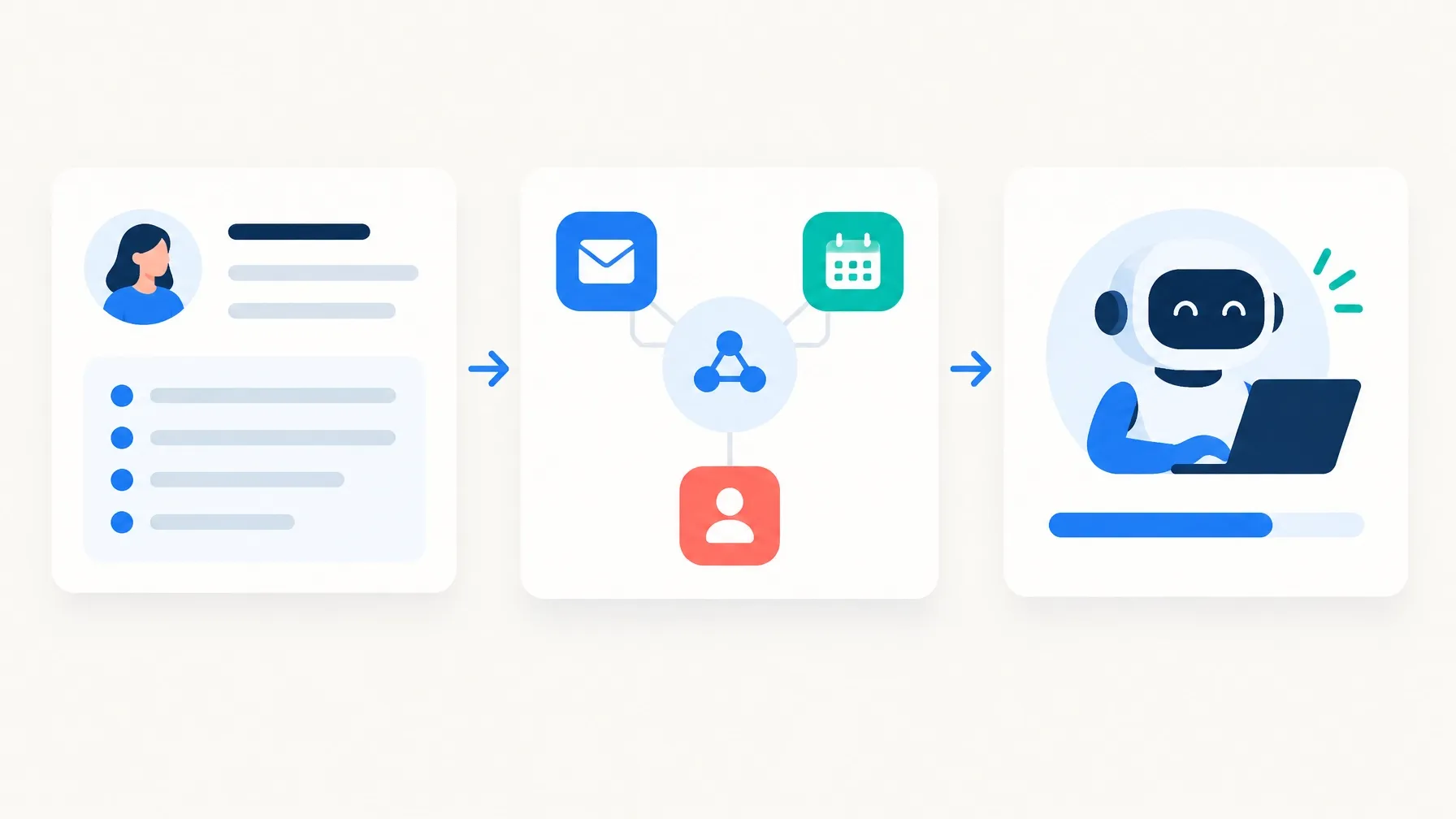
Open Marblism and describe the worker you want in plain English. For example:
“Create an AI worker that reviews new customer inquiries, identifies the main request, suggests a response, and flags anything that requires a human decision. It should never send a message without approval.”
The important part is that you are describing the outcome, not writing software.
Marblism’s AI workers are designed to take on defined responsibilities for you. You can start with one role, give it instructions, and adjust the role as you learn what works.
At this stage, keep the setup simple. Do not add every possible instruction, data source, or workflow. Give the worker the minimum context it needs to complete its first job.
Minute 4: Set permissions and oversight
This is the step that separates a useful AI worker from a risky one.
Before an agent can act, decide what it may do independently and what requires your approval.
A simple permission model looks like this:
| Action | Suggested control |
|---|---|
| Read internal instructions | Allowed |
| Draft an email | Allowed |
| Send an external email | Human approval |
| Create a report | Allowed |
| Delete data | Not allowed |
| Change pricing or contracts | Human approval |
| Make a financial commitment | Human approval |
You should also define what the agent must show you. At a minimum, ask for:
- The task it completed
- The sources or information it used
- The result it produced
- Any uncertainty or missing information
- The actions waiting for approval
This directly addresses the biggest objection many people have about AI workers: “What is it doing when I am not watching?”
The answer should be visible activity, clear permissions, review points, and a way to stop or change the worker.
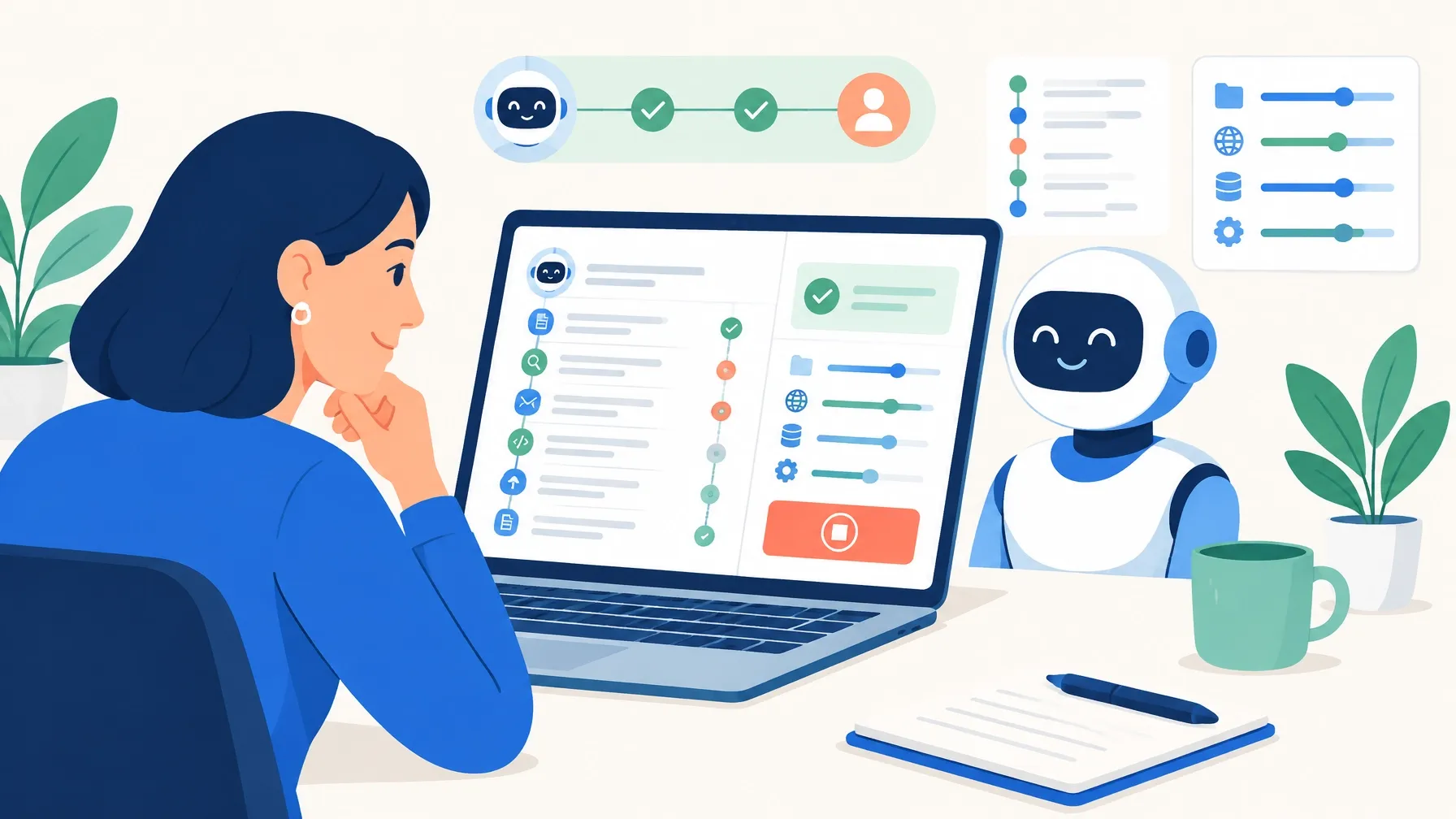
Transparency is not a feature you add after something goes wrong. It should be part of the initial job description.
Minute 5: Run one real task
Give the AI worker a small, real assignment.
For example:
- Review the five newest leads
- Summarize yesterday’s support requests
- Prepare one competitor brief
- Draft responses to three routine emails
- Turn a meeting transcript into action items
Review the result carefully. Do not judge the entire idea of AI agents based on one imperfect output. Instead, look for patterns:
- Did the worker understand the goal?
- Did it follow the format?
- Did it make unsupported assumptions?
- Did it know when to ask for help?
- Did it save meaningful time?
Then improve the instructions.
The first version of an AI worker is rarely the final version. Like a new employee, it becomes more useful when you provide examples, corrections, and clearer expectations.
How to make your AI worker reliable
Once the first task works, use these improvements:
Give it examples
Show the agent two or three examples of good and bad outputs. Examples often communicate expectations more clearly than additional paragraphs of instructions.
Set a fixed output format
Ask for headings, bullet points, tables, or a specific sequence. Consistent formatting makes results easier to review and reuse.
Add a confidence rule
Tell the agent what to do when information is incomplete:
“If you cannot verify a claim, label it as unverified instead of guessing.”
Keep a human approval step
Approval is especially important for external communication, sensitive data, money, legal matters, and decisions that affect people.
Track time and quality
Measure the result against a baseline:
- How long did the task take before?
- How long does it take now?
- How often does the output need editing?
- How many tasks can the worker complete?
- What is the cost per completed task?
This is how you determine whether the AI worker is producing real value, not just generating impressive demonstrations.
Are AI agents really cheaper than human hires?
They can be, but the comparison needs to be honest.
An AI worker may have costs for:
- The platform
- Model usage
- Connected tools
- Setup and configuration
- Human review
- Ongoing maintenance
For repetitive digital work, the total can still be 60–80% lower than the cost of a fully loaded human hire. The savings are most likely when the task is high-volume, well-defined, and completed using existing digital systems.
The wrong approach is to assume that an AI agent is free labor. The right approach is to compare the total cost of the current process with the total cost of the AI-assisted process.
If an AI worker saves five hours every week and produces work that a person can quickly approve, it may be valuable even before it operates fully autonomously.
What should you hire next?
After your first AI worker is reliable, consider adding roles that complement it:
- A research worker that gathers information
- A writing worker that turns research into drafts
- A review worker that checks accuracy and formatting
- A scheduling worker that coordinates next steps
- A reporting worker that summarizes activity and results
The goal is not to create a swarm of agents for its own sake. The goal is to build a small, accountable team of AI workers that handles useful work while people stay in control of important decisions.
If you expand later, there are good future internal linking opportunities around topics such as AI employees vs virtual AI workers, AI business automation mistakes, and are virtual AI workers worth it.

FAQ
How much does it cost to hire an AI agent?
The honest answer is that it depends on the task, the platform, the model usage, and how much human review you keep in the process. For repetitive digital work, it can be much cheaper than a full human hire, but it is not free and it still needs setup and oversight.
Do I need coding skills to hire AI agents?
No. With a no-code platform like Marblism, most people can hire AI agents by describing the role, the task, and the rules in plain English. You still need to think clearly about the job, but you do not need to write software.
Can AI agents replace human employees?
Sometimes they can reduce manual work, but they are usually best at handling narrow, repetitive tasks. In most cases, AI workers support people rather than fully replace human employees, especially where judgment, approvals, or sensitive decisions are involved.
How do I keep an AI agent from making mistakes?
You reduce mistakes by giving clear instructions, limiting permissions, setting a fixed output format, and keeping a human approval step for higher-risk actions. The best approach is to start small, review results closely, and improve the instructions over time.
Start with one AI worker today
You do not need a long implementation plan to hire AI agents.
Choose one recurring task. Write a clear job description. Set permissions. Run one real assignment. Review the result.
That is enough to move from curiosity to evidence.
With Marblism, you can start building AI workers around the work your team already does, without code, without a major software project, and without giving up oversight. If you want to hire AI agents without turning the process into a big IT project, start with one controlled workflow and build from there.
Scan to try it and get started with Marblism.

The best first AI agent is not the most ambitious one. It is the one that completes a real task this week and makes your next week easier.